
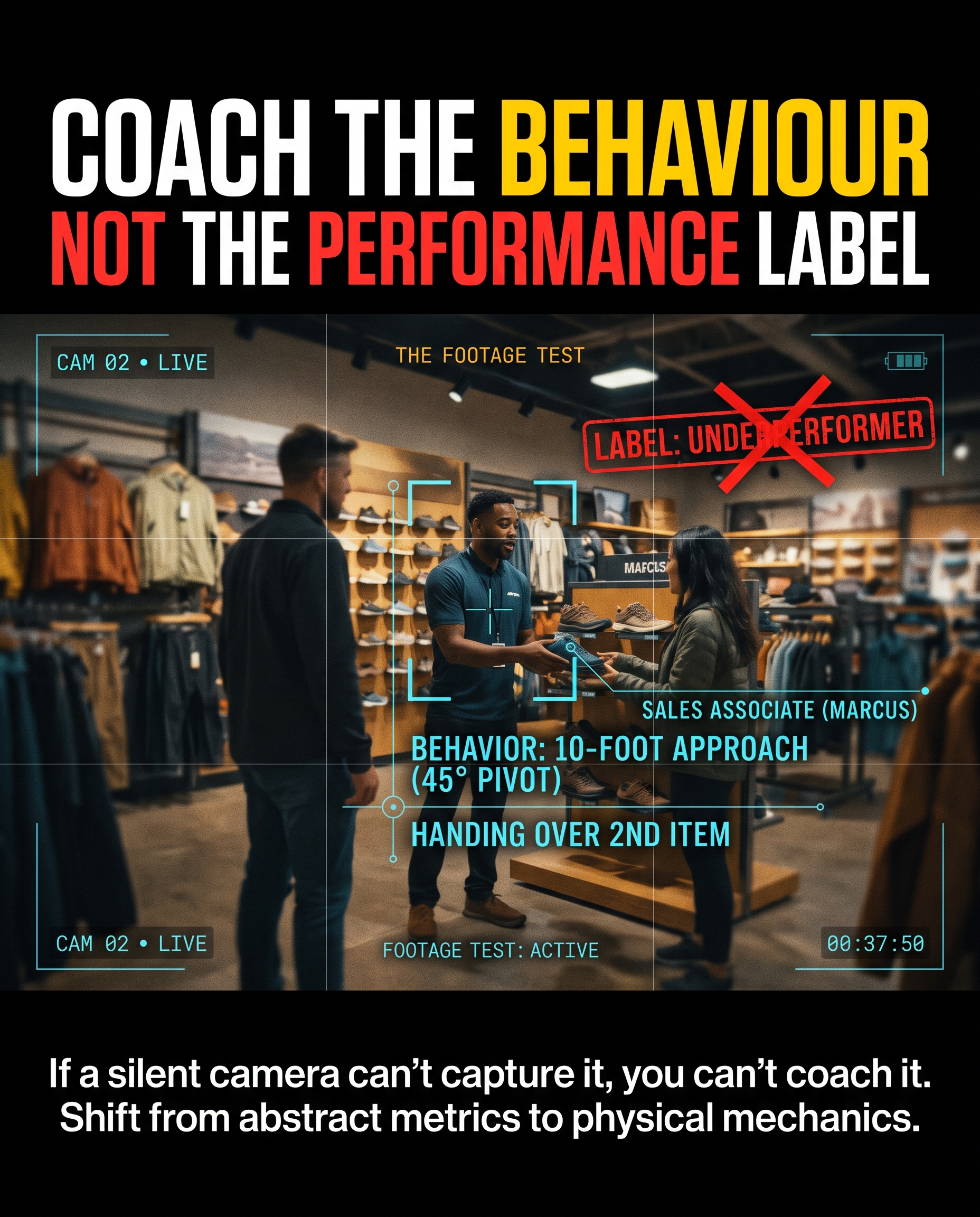
Coach the Behavior, Not the Performance Label
When a retail store manager looks at the weekly dashboard and spots an associate trailing the team, the immediate instinct is to identify the problem in terms of the scoreboard.
Conversion is sitting at eleven percent against an eighteen percent store target. Units per transaction are hovering at 1.2.
The associate is cataloged in the manager’s mind, and often in quarterly documentation, as an underperformer.
The trouble starts when that word leaves the spreadsheet and enters the coaching conversation.
Telling someone they are underperforming communicates an evaluation, not an instruction.
It informs them that their current reality is unacceptable to the business, but it leaves them completely blind to the mechanics that produced the shortfall.
An employee cannot execute an adjective. They cannot wake up tomorrow morning, walk onto the sales floor, and physically do more “urgency,” better “engagement,” or higher “conversion.”
Those are financial and statistical outcomes. They are the downstream results of physical actions taken or avoided across an eight-hour shift.
When you coach the label, you trigger predictable friction. The associate becomes defensive because an abstract label sounds like an indictment of their character or effort.
Alternatively, they nod along, promise to try harder, and return to the floor with no clearer idea of what to do differently than they had before the conversation began.
To make coaching fair, credible, and immediately actionable, you have to discard the summary score and locate the physical mechanics that created it.
The Footage Test
The most reliable thinking device for bridging the gap between a metric and a coaching moment is what you might call the Footage Test.
Imagine you are reviewing silent security camera footage of your sales floor. You cannot hear the internal dialogue of your team. You cannot read their performance reviews.
You cannot see the daily sales report glowing on your back-office monitor. All you have is the video feed showing physical bodies moving through physical space.
If a manager claims an employee has “a bad attitude,” you cannot see that on the footage.
What you actually see is an associate who remains stationed behind the cash wrap while three distinct groups of customers cross the front threshold, only making eye contact once the shopper is within arm’s reach of the counter.
If a manager says an employee “lacks product knowledge,” you cannot see that either.
What you see on the footage is an associate who steps toward the shelf tag to read the fine print when a customer points to a display item, rather than picking the product up and placing it directly into the customer’s hands.
The Footage Test forces a strict operational rule: if a third party watching silent video cannot point to the exact physical movement, posture, pause, or action as it occurs, it is not a behavior yet.
It is still an interpretation.
This test protects both sides of the management relationship. It protects the associate from subjective, mood-based critique that feels personal and impossible to satisfy.
It protects the manager from wasting half an hour delivering vague motivational speeches that change nothing about tomorrow’s sales ledger.
Every lagging performance indicator in retail breaks down into a sequence of observable moments. Your job as a leader is never to manage the metric directly.
You manage the physical habits that make the metric inevitable.
Deconstructing the Associate on Floor Two
Consider how this plays out in a common retail environment, such as a specialty footwear and outdoor apparel shop.
Suppose an associate named Marcus has been on the team for four months. His conversion rate is consistently the lowest on the weekend team, and his accessory attachment rate is near zero.
A standard supervisory response sounds familiar: “Marcus, your conversion is lagging. You’re six points below the store benchmark, and your attachment numbers tell me you aren’t offering the full basket.
We need you to be more proactive with shoppers, show more initiative, and push the add-ons at the register.”
Marcus leaves that conversation feeling deflated and anxious. He knows he is behind, but he doesn’t know where the gap lives.
In response, he heads back out to the sales floor and attempts to display “initiative.” He hovers around customers too closely.
He interrupts people who have just crossed the threshold with a rushed, aggressive greeting: “Can I help you find something today?”
Customers immediately deploy their defensive reflex: “Just looking, thanks.” Marcus backs off, his confidence further dented, and retreats to straightening shoe boxes on the back wall.
At checkout, remembering the instruction to push add-ons, he points nervously to a stack of waterproofing spray by the card reader and asks, “Did you want any protector spray with those boots?”
The customer glances down, shakes their head, and taps their card. Marcus feels like a failure, and the manager assumes Marcus simply lacks sales talent.
Now look at what happens when the manager applies behavioral diagnosis instead of performance labeling.
Instead of looking at the register logs, the manager spends twenty minutes watching Marcus work with three consecutive customers, evaluating only observable physical patterns.
The manager notices three distinct, repeatable breakdowns.
First, Marcus initiates contact from behind the cash desk or while walking away toward inventory shelves, using a closed question that invites a dead-end response.
He does not position himself at an open, forty-five-degree angle within the customer’s secondary field of vision before speaking.
Second, when a customer asks to try on a hiking boot in a size ten, Marcus runs to the stockroom, retrieves only that single pair in that single size, hands the box to the customer, and steps back two paces in silence while the shopper struggles with the laces.
He does not bring an alternative style, nor does he pull a pair of technical merino wool socks to test the fit under genuine trail conditions.
Third, Marcus treats product care as a transaction tax at the till. He introduces the waterproofing spray only after the primary purchase is rung up and the customer has already reached for their payment card.
When the manager calls Marcus in for a conversation this time, the word “underperformance” never enters the room. The conversation is tactical, clear, and calm:
“Marcus, I watched how you handled the boot fitting at eleven this morning. You found the exact size quickly, which was great.
Next time you head to the back room for a hiking shoe, I want you to bring out two boxes instead of one: the pair they asked for, and one alternative with a wider toe box or stiffer shank for comparison.
When you bring them out, don’t hand them the box. Take the shoe out yourself, loosen the laces completely, and hand them a technical sock from the fitting rack so they feel the actual fit before they tie it.
Let’s practice what you say when you set that second pair down.”
Notice the shift in cognitive load. Marcus is no longer defending his worth as an employee. He doesn’t have to decipher what “initiative” looks like. He has a concrete, physical script to execute.
He knows which boxes to pull, how to present the physical item, and at what second in the customer journey the accessory must be introduced. The anxiety disappears because the target is tangible.
Translating Results into Motion
Retail leadership becomes remarkably straightforward when you adopt a simple decision rule: never critique a number until you have pinpointed the three physical seconds that preceded it.
When you look across your store, every recurring metric problem can be mapped directly to an observable physical routine:
Low conversion is rarely an effort problem. It is almost always an approach problem: greeting too late, greeting with closed questions, or failing to transition from polite acknowledgment to a diagnostic discovery question about why the customer came in today.
Low average transaction value is rarely a customer unwillingness problem. It is an accompaniment problem: associates pointing customers across the floor toward an aisle instead of walking with them, or waiting until the cash counter to introduce items that belong in the fitting room.
Weak loyalty sign-ups are rarely an audience problem. It is an explanation problem: asking a flat “Do you want to join our rewards program?” instead of explaining the immediate financial savings before scanning the third item.
When you coach the behavior, accountability actually increases. When you tell someone they are underperforming, they can hide behind excuses about traffic, inventory, or uncooperative shoppers.
But when the standard is clear, observable physical actions, there is nowhere to hide, and more importantly, no confusion about how to win.
The question every manager should carry onto the floor is simple: if you had to perform the exact physical movement you expect from your associate right now, could you demonstrate it without using a single adjective?
Once you master this translation for the people who are struggling, an interesting secondary pattern begins to show up among the associates you consider your top producers.
You will notice that many of your star performers cannot actually explain why their numbers are high, which means their success is often based on accidental habits they cannot transfer to anyone else.
AI Diagnosis
AI Prompt
Act as an expert retail management coach who uses the Footage Test to translate abstract performance labels into observable floor behaviours. I’m going to share a performance problem or metric deficit: [DESCRIBE THE PERFORMANCE DEFICIT OR CRITIQUE, e.g., ‘My sales associate has low conversion and almost zero accessory attachments on busy weekend shifts; I keep telling him he needs more initiative, urgency, and better customer engagement, but nothing is improving’]. Run this through the Footage Test to strip away all subjective labels, vague adjectives, and scoreboard metrics. First, diagnose the issue by listing 3 distinct, observable physical breakdowns that silent security camera footage would likely capture on the sales floor, such as physical positioning, approach timing, question structure, or when merchandise is presented. Second, translate each breakdown into an exact physical replacement behaviour described entirely through concrete movements and timing, without using abstract adjectives like proactive, energetic, or engaged. Third, write a concise, conversational coaching script I can deliver on the sales floor in under two minutes that eliminates defensive friction, focuses strictly on these physical actions, and ends with one immediate tactical exercise we can run through together right now.
AI Output
1. Observable Physical Breakdowns (The Footage Diagnosis)
Running this scenario through the Footage Test strips out words like “urgency” and “initiative.” On a silent video feed, three specific mechanical breakdowns become immediately visible:
-
Anchor Camping at the Till: The associate remains physically positioned behind the cash counter or within three feet of a primary merchandise display, looking out passively. When a shopper enters the zone, the associate remains static until the customer steps directly to the counter or stops at an adjacent rack.
-
The Passing Fly-By Approach: When the associate does move across the floor, they deliver greetings while in motion, walking past the customer at a 90-degree angle or from behind their shoulder, asking a closed question (“Finding everything okay?”) without stopping their feet or squaring their body to the customer.
-
The Register Pitch: Accessories remain untouched on the shelf during the entire interaction. The associate only introduces secondary items (socks, cleaner, warranties, or add-ons) after the customer has walked to the register, placed their primary item down, and reached into their pocket or purse for payment.
2. Concrete Replacement Behaviors
Here is the translation into specific physical movements, positions, and timing:
-
Replacement 1: The 10-Foot Perimeter Pivot
-
Action: Step out from behind the counter into an open lane on the floor. When a customer enters within ten feet, stop walking, plant both feet at a 45-degree angle to them (not blocking their path), make eye contact, and count two seconds before speaking.
-
Mechanism: Eliminates the closed, defensive posture of the cash wrap and prevents startling shoppers from behind.
-
-
Replacement 2: The Two-Item Handoff
-
Action: When a customer asks for a product or reaches for a display unit, retrieve two options instead of one: the item requested, plus one related complementary item or alternate variant. Hold the requested item in your left hand and physically hand the secondary item directly into the customer’s hands before opening the packaging of the primary product.
-
Mechanism: Puts product in the customer’s hands within the first 90 seconds of the interaction, anchoring basket building on the sales floor rather than at the cash wrap.
-
-
Replacement 3: The Mid-Discovery Companion Bridge
-
Action: While the customer is testing, trying on, or inspecting the primary product, place the accessory directly adjacent to the item being evaluated (e.g., place technical socks right next to the boot fitting bench, or rest the protective lens cleaner directly beside the camera display). Introduce the item by describing how it maintains or completes the primary item before asking for the sale.
-
Mechanism: Moves the accessory introduction from a post-sale friction point at checkout into part of the primary solution on the floor.
-
3. Two-Minute Floor Coaching Script
Manager: “Alex, quick pause with you. You’ve got great product technical knowledge, but right now we’re losing sales because of where and when the conversation is happening.
On your last three interactions, you brought out only the single item the customer asked for, and you brought up the accessory once they were already pulling out their card at the till.
That feels like an extra charge to them, and it makes your job twice as hard.
Starting with the next shopper: every time someone asks to see an item, you are going to pull two items from the back: the exact item they asked for, plus the matching accessory that protects or completes it.
You will hand them the accessory to hold while they inspect the main piece.
Let’s do a 45-second dry run right now. I’m a customer looking at this jacket. Show me how you bring out the waterproofing wax and hand it to me before I unzip the coat.”