
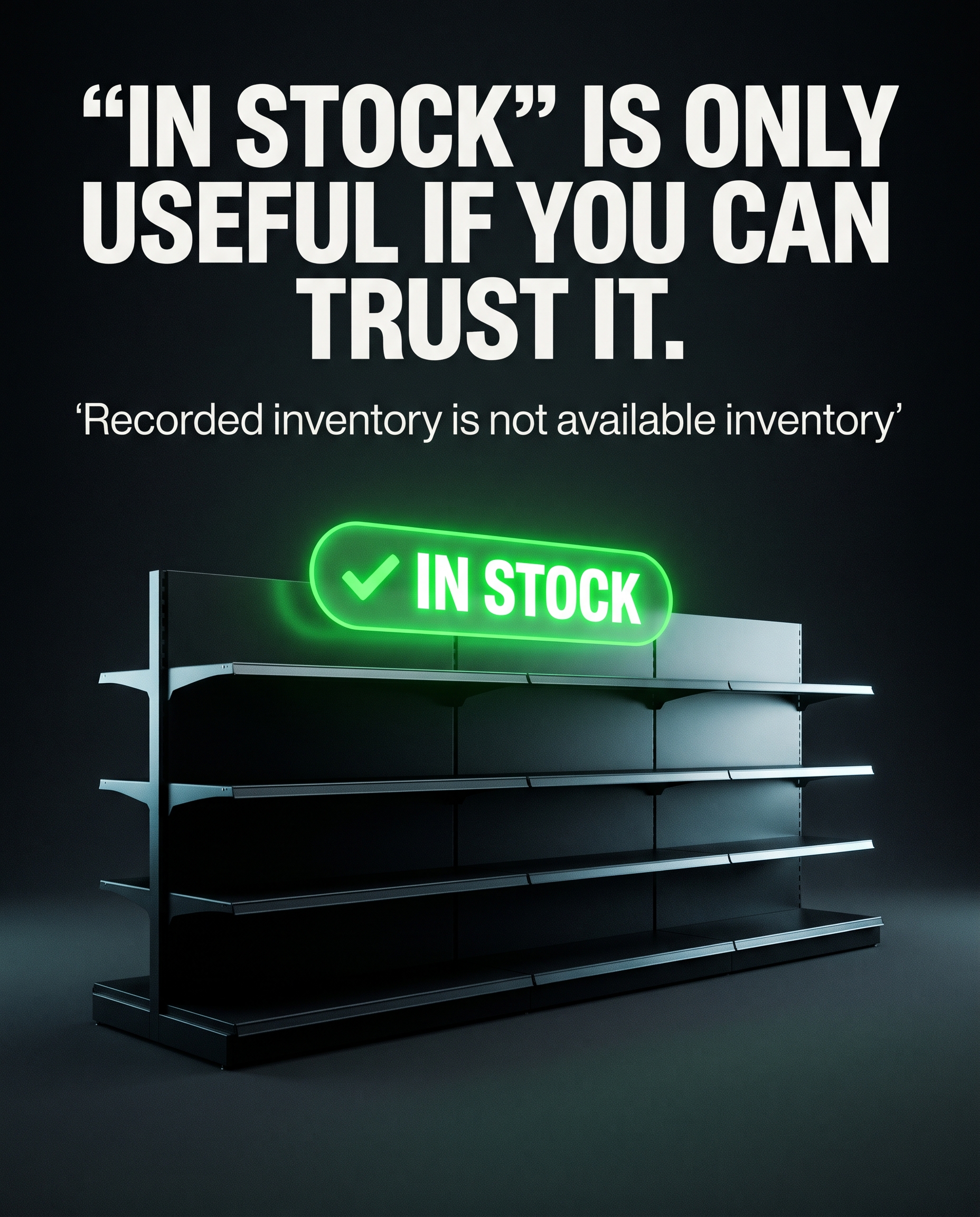
“In Stock” Is Only Useful If You Can Trust It
Most omnichannel retailers treat inventory visibility as a math problem: take what arrived, subtract what sold, and publish the remainder online.
If the database says three units are sitting in Store 14, the product page confidently declares the item in stock for same-day pickup.
Then the customer places the order.
Forty minutes later, an associate walks the floor with a handheld scanner, scans the shelf where the item belongs, finds an empty peg, checks the backroom staging area, and ultimately triggers a fulfillment cancellation.
The customer receives an automated email explaining that their item is suddenly unavailable.
The brand experiences a customer service contact, a lost sale, and a measurable hit to customer trust. The inventory ledger, meanwhile, still insists those three units exist.
This failure does not happen because modern retail software fails to add and subtract.
It happens because digital commerce operates on recorded inventory, but fulfillment depends on actionable inventory. When retailers treat those two states as identical, they create false availability.
A customer does not care what your database believes you own. They care whether an item can be located, confirmed, packed, and handed to them without friction.
Until retail teams understand the physical and operational leakages that sit between a system balance and a real item, publishing real-time inventory will remain one of the most reliable ways to disappoint high-intent buyers.
The Mirage of the Ledger Balance
The core misunderstanding begins in the enterprise resource planning (ERP) system or warehouse management system (WMS).
In these platforms, inventory exists as a static integer attached to a stock keeping unit (SKU) and a location code. It is binary: it is either on hand or it is not.
In a physical store or hybrid distribution node, inventory is not a static number. It is an operational flow subject to time lags, physical displacement, and human behavior.
A recorded unit can fail to be an actionable unit for several predictable reasons:
First, receiving latency. A pallet arrives at the store dock at 8:00 AM. A receiving clerk scans the master bill of lading, and the entire shipment instantly increments the store’s visible inventory online.
But the boxes are still shrink-wrapped on a pallet behind three other pallets. It will take six hours for the store team to break down the pallet, verify individual cartons, and stock the shelves.
If an online pickup order drops at 8:30 AM, that product is technically on the property, but operationally invisible to the picker.
Second, physical displacement. In retail environments, customers carry items around the store and abandon them in random aisles.
An associate might set aside an item behind a cash wrap to process a customer hold that was never recorded in the system.
The system balance is positive, but the physical unit is not where the picker’s device directs them to look.
In a fulfillment window measured in minutes, an item that cannot be found quickly is functionally identical to an item that was never delivered.
Third, returns processing lag. When a customer brings a jacket back to a store, the cashier scans the receipt and refunds the payment. The return immediately logs back into on-hand stock.
However, that jacket often sits in a return bin behind customer service for hours, waiting for tagging, inspection, or steaming before it returns to the sales floor.
If an online order claims that single returned unit thirty minutes later, the store associate usually cancels the pick because the item is not on the rack.
Fourth, latent shrink. Theft, miscounts, vendor shortages, and unrecorded damaged goods erode physical inventory silently. Retailers typically discover shrink during periodic physical cycle counts.
Between those counts, ghost inventory sits on the digital ledger. The system believes it has two units; in reality, someone walked out the front door with both of them three weeks ago.
Fifth, uncommitted customer baskets. When an omnichannel engine checks availability, it often ignores items currently riding inside physical shopping carts on the sales floor.
Two customers can be standing in the checkout lane with the last two units of an air filter while an online buyer clicks “Order for Pickup” for that exact filter.
The online system routes the order, but the physical stock leaves through the cash register three minutes before the store picker even receives the pick list.
When you add these operational realities together, you realize that raw on-hand inventory is not an operational truth. It is merely a historical hypothesis.
The Actionable Inventory Ratio
To manage this gap, operators need a cleaner mental model than simply looking at on-hand stock versus safety stock.
A more reliable way to evaluate store-level availability is the Actionable Inventory Ratio: the percentage of recorded units that an associate can locate and pick within standard operating time limits on the first attempt.
Consider a practical example. A national home improvement chain rolled out ship-from-store across two hundred locations.
On paper, their fulfillment strategy looked sound: by fulfilling regional delivery orders from local stores rather than distant distribution centers, they could cut last-mile shipping times from three days to one day.
In their pilot market, they turned on ship-from-store for power tools and accessories, setting their system to expose inventory online down to a safety threshold of one unit.
If Store 22 showed two cordless drills, both were available to purchase online.
Within two weeks, their fulfillment cancellation rate spiked to fourteen percent.
When regional leadership reviewed the cancellations, store managers pointed out that their physical pick rate for power tools was chronically broken.
High-value tools were frequently locked in security cages, kept in overhead storage risers requiring a forklift, or caught in the receiving staging area.
When store pickers were dispatched to grab a drill to pack for an online order, they had six minutes to fulfill the line item before hitting a productivity penalty.
If the drill was buried on an unworked pallet or the keyholder for the display cage was assisting a walk-in contractor, the picker marked the item as “not found” to keep their pick rate within standard.
The inventory was not missing from the building; it was absent from the actionable workflow.
The retailer resolved the issue not by adding more inventory, but by changing how they defined availability.
First, they decoupled receiving confirmation from digital availability, instituting an operational rule: stock received at the dock was barred from appearing as pickable online inventory until it was scanned into a specific shelf, bin, or verified sales-floor location.
Second, they adjusted the digital availability buffer dynamically based on SKU velocity and physical storage type.
Bulk goods stored in accessible floor bays could be sold down to a buffer of one; goods stored in locked cages or high overheads required an available threshold of three before showing online.
Their fulfillment cancellation rate dropped from fourteen percent to under two percent in thirty days.
Total sales did not drop; instead, reliable order completions increased because the system stopped selling promises it could not execute.
The repeatable lesson from that deployment applies across every category of omnichannel retail:
Inventory that cannot be located in the flow of work does not exist.
If an associate cannot put their hand on a unit within the standard pick window, it does not matter that the accounting ledger claims it was paid for and received.
For the customer waiting on the other end of the transaction, that inventory is completely imaginary.
The Three-State Availability Diagnostic
To protect customer trust without holding absurd levels of dead stock, retailers must shift their thinking from a two-state model (In Stock vs. Out of Stock) to a three-state diagnostic model for every stocking location:
-
System On-Hand: What the financial ledger shows as owned within the four walls.
-
Physically Present: What actually exists inside the building, accounting for unrecorded theft, damage, and customer carts.
-
Actionably Available: What is physically present, currently uncommitted, and sitting in an accessible location where a picker can retrieve it immediately without special intervention.
Most operational failures happen when the customer-facing interface exposes System On-Hand directly to the front-end catalog. High-performing retailers only expose Actionably Available inventory.
To diagnose whether your business is suffering from false availability, apply this simple test: pull your store fulfillment cancellation logs for the past ninety days and filter exclusively for orders canceled due to “item not found.”
Then, cross-reference those SKUs against store inventory balance adjustments made in the subsequent seven days.
If your team canceled an online order because the item was not found, but your store inventory records were never adjusted downward to reflect a loss, you do not have a shrink problem.
You have a velocity and access problem. You are selling inventory faster than your physical store operations can make it pickable.
Closing this gap requires treating the sales floor and backroom as living operations rather than static warehouses.
It means requiring secondary verification before an item marked as received appears on the web.
It means establishing dynamic buffers that account for the time it takes to move an item from a return counter back to a sales fixture.
Most critically, it means accepting that suppressing an online listing is always cheaper than processing a fulfillment cancellation.
A customer who sees an item marked “out of stock” may choose an alternative, check back later, or order a replacement.
A customer who buys an item marked “in stock,” travels to your store, and is told it cannot be found will remember that your digital promises cannot be trusted.
The real question for retail operators is not how many units your system tracks across your network, but how many of those units your frontline teams can actually lay their hands on before the customer pulls up to the curb.
AI Diagnosis
AI Prompt
Act as an omnichannel inventory and retail operations strategist. I’m going to share details about our current store fulfillment operations and product lines, and your job is to audit our setup to eliminate false availability and reduce order cancellations. Analyze my scenario using the distinction between system on-hand inventory and actionably available inventory. Pinpoint exactly where physical displacement, receiving latency, returns processing lag, floor shopping carts, or storage retrieval friction are creating ghost availability that our store associates can’t pick within standard operating windows. Then, organize your findings into three direct sections: first, a breakdown of our most dangerous operational leakage points where recorded units fail to match pickable units; second, a dynamic inventory buffering matrix recommending specific safety stock thresholds and digital exposure rules based on each item’s storage location and retrieval friction; and third, two immediate operational guardrails we can roll out to our stores this week to stop our systems from publishing stock until it’s physically accessible. Here are the details of our operation: [Describe your fulfillment setup, product category, and current pain points, for example: We run an omnichannel sporting goods chain with 45 stores offering ship-from-store and 2-hour curbside pickup. Our pickup cancellation rate is 11%, mostly on hunting gear, fitness weights, and bicycles. Inventory shows on the website immediately upon delivery scan at the loading dock, returns are processed back to system stock at the front register, and bikes are often stored in an upper mezzanine that requires a safety harness to retrieve.]
AI Output
An 11 percent cancellation rate in store-fulfilled orders is an operational emergency.
It signals that your digital catalog is treating your physical stores as sterile distribution centers rather than chaotic, high-traffic retail environments.
In a 2-hour curbside pickup model, an associate typically has 15 to 20 minutes to claim, pick, and stage an order.
If an item cannot be reached and scanned within two minutes of arriving at the designated shelf, the associate will mark it unfulfilled to preserve their pick-rate metrics.
Here is the operational audit of your 45-store network, broken down into your structural leakages, a dynamic buffering matrix, and two immediate guardrails to deploy this week.
1. The Five Operational Leakage Points
Your 11 percent cancellation rate is concentrated in specific categories because each introduces physical friction that breaks standard picking windows:
-
Dock-to-Digital Receiving Latency (All Categories): When an inbound shipment is scanned at the loading dock, your ERP immediately flags those units as available for sale. However, those items are still wrapped on pallets, buried behind other freight, or sitting in staging. When a 2-hour pickup order drops 30 minutes after delivery, the store associate cannot break down an entire pallet to find a single box of hunting broadheads. The item is on the property, but operationally invisible. Result: an immediate cancellation.
-
Mezzanine and High-Friction Retrieval (Bicycles): Storing built or boxed bicycles in an upper mezzanine that requires a safety harness is an operational barrier to rapid fulfillment. When a curbside order for a bike arrives, a lone associate on the floor cannot abandon customers, suit up into fall-protection gear, and operate retrieval equipment within a short picking window. If certified equipment operators are not on shift, the picker flags the unit as missing or out of stock simply to clear their task queue.
-
Front-Register Returns Recirculation Lag (Apparel, Footwear, Gear): When a return is processed at the front counter, point-of-sale software typically increments store on-hand inventory instantly. In reality, that returned item sits in a plastic tote behind the customer service desk for four to eight hours awaiting re-tagging, inspection, folding, or restocking. Digital channels immediately sell that single unit, dispatching a picker to an empty sales-floor fixture.
-
High-Security and Restricted Access Lockouts (Hunting Gear): Hunting optics, trail cameras, ammunition, and knives are typically locked behind glass cases or stored in a secure cage. If the primary keyholder is assisting an in-store customer, conducting a background check, or on a break, the fulfillment associate faces a choice: wait ten minutes for keys or trigger a nil-pick and move to the next order. They almost always choose the cancellation.
-
Displacement and Latent Shrink (Fitness Weights): Cast-iron dumbbells, kettlebells, and weight plates suffer from high physical displacement and inventory drift. In-store shoppers frequently pick up weights, test them, and abandon them across the store. Furthermore, mismatched pairs and unrecorded damage create phantom inventory balances. If your system shows two 35 lb dumbbells on hand, there is a high probability that one is missing, damaged, or currently sitting in a shopper’s cart on their way to the cash register.
2. Dynamic Inventory Buffering Matrix
To prevent orders from routing against phantom stock, you must replace flat safety stock thresholds with dynamic availability rules dictated by physical accessibility and category velocity.
| Storage Profile & Category | Primary Friction Factor | Recommended Digital Buffer | Digital Exposure Rule |
| Bicycles (Upper Mezzanine / Harness Required) | Physical retrieval requires safety gear and multiple staff; assembly/check needed. | Buffer: 2 units (For single-unit stock, display as “Call Store to Verify”). | Only expose stock if the bicycle has been pre-assembled, safety-checked, and scanned into an active ground-level staging bay. |
| Hunting Gear (Locked Display Cases & High Security) | Keyholder dependency; high physical customer consultation at the counter. | Buffer: 1 unit (Never sell down to zero balance online). | Expose inventory only when on-hand count is 2 or greater. If the item is the floor display model, suppress digital availability entirely. |
| Fitness Weights (Open Floor / Heavy Displacement) | Customer carting; misplacement across wrong racks; weight-class discrepancies. | Buffer: 3 units for common SKUs; 2 units for specialty weights. | Expose inventory when on-hand count exceeds the buffer. Require weekly single-SKU cycle counts on high-velocity dumbbell runs to clear ghost balances. |
| Freshly Received Freight (Dock Staging) | Carton breakdown time; unverified pallet contents; sorting delays. | Buffer: 100% suppression at dock scan. | Zero digital availability until the carton/unit receives a secondary “Put-Away / Shelf Scan” in an accessible sales location. |
| Customer Returns (Front Counter Staging) | Item sitting in return bins; uninspected, un-steamed, or missing packaging. | Buffer: 100% suppression at POS return. | Automatically route returned stock to a virtual “Holding” location code for 12 hours before releasing to the ecommerce availability pool. |
3. Two Immediate Operational Guardrails for This Week
You do not need an enterprise software overhaul to cut your cancellation rate in half. Implement these two workflow rules across all 45 stores immediately:
Guardrail 1: Enforce a Two-Scan “Dock-to-Stock” Quarantine
Decouple freight arrival from ecommerce availability. When trailers are unloaded at the back dock, instruct receiving teams to scan cartons into a restricted location code (e.g., DOCK_HOLD).
-
Configure your inventory feed to exclude
DOCK_HOLDfrom the available-to-promise (ATP) quantity shown on your website and app. -
Units only become digitally sellable when an associate performs a secondary scan that places the merchandise into a verified sales-floor bin, shelf location, or active pick zone (
FLOOR_STOCK). -
If a pallet cannot be worked on the day it arrives, its contents will never generate an unpickable 2-hour curbside order.
Guardrail 2: Establish a 12-Hour “Virtual Quarantine” for All Register Returns
Reconfigure your POS return workflow so that items accepted at customer service do not immediately increment sellable online stock.
-
When a cashier scans a returned item, the system should automatically allocate the inventory to a non-fulfillable location code (e.g.,
RETURN_STAGE). -
Create a standard operational sweep at 7:00 AM and 2:00 PM where dedicated associates inspect, re-ticket, and return these items to the sales floor.
-
Only when the associate scans the returned item back into its primary sales fixture or backroom pick bin is the inventory transferred from
RETURN_STAGEto sellable digital inventory.
Implementing these two changes will instantly eliminate dock-search cancellations and empty-shelf return chases, protecting both your store pickers’ productivity and your customers’ trust.