
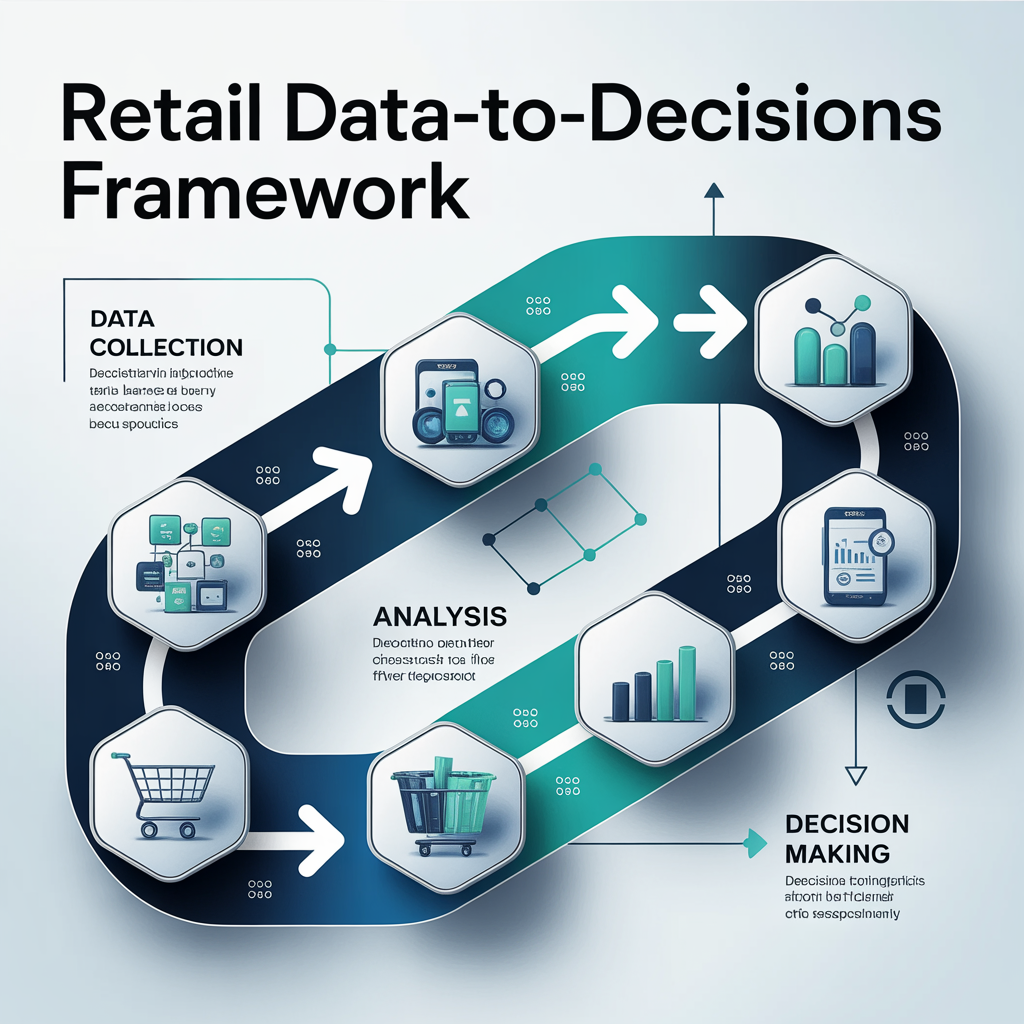
📊 Retail Data-to-Decisions Framework
Turn Scattered Retail Data Into Clear, Fast, Profit-Driving Moves
Overview
Most retailers are not lacking data. They are drowning in it.
This framework shows you how to turn raw numbers into smart decisions you can actually act on—so you stop staring at dashboards and start making moves that grow revenue, protect margin, and sharpen performance.
SECTION 1: The “Data-to-Decisions” Operating Model
Retail data only becomes valuable when it answers 3 questions:
-
What is happening?
This is your visibility layer.
- Sales trends
- Conversion changes
- Inventory shifts
- Customer behavior patterns
-
Why is it happening?
This is your insight layer.
- Pricing changes
- Traffic quality
- Product demand shifts
- Seasonality and timing
-
What should I do next?
This is your action layer.
- Adjust pricing
- Reorder inventory
- Shift ad spend
- Launch a recovery campaign
The Core Rule
Data without a decision is just digital clutter.
Every metric you track should lead to one of these outcomes:
- Fix something
- Scale something
- Test something
- Stop something
SECTION 2: The 5 Retail Data Buckets That Actually Matter
Do not track everything equally. Track what drives decisions.
-
Revenue Data
Use this to understand performance at the top level.
Key metrics:
- Total sales
- Average order value
- Units sold
- Revenue by product
- Revenue by channel
Questions this data answers:
- Are sales up or down?
- Which products are carrying the business?
- Which channel is making the most money?
Decision examples:
- Push winning channels harder
- Cut weak campaigns
- Feature top revenue products more often
-
Conversion Data
This tells you whether shoppers are buying or bouncing.
Key metrics:
- Conversion rate
- Add-to-cart rate
- Checkout completion rate
- Cart abandonment rate
- Product page engagement
Questions this data answers:
- Where are people dropping off?
- Is traffic converting?
- Is the product page doing its job?
Decision examples:
- Improve product pages
- Rewrite offers
- Test stronger CTAs
- Fix friction in checkout
-
Inventory Data
This protects cash flow and prevents chaos.
Key metrics:
- Stock on hand
- Sell-through rate
- Stockout frequency
- Days of inventory left
- Slow-moving SKUs
Questions this data answers:
- What is about to run out?
- What is tying up cash?
- Which SKUs should be reordered or discounted?
Decision examples:
- Reorder top sellers sooner
- Bundle slow movers
- Stop buying weak products
- Increase safety stock on winners
-
Customer Data
This shows you who is buying and how often.
Key metrics:
- Repeat purchase rate
- Customer lifetime value
- New vs returning customers
- Time between purchases
- Customer segment performance
Questions this data answers:
- Are customers coming back?
- Which segment is most valuable?
- Who needs re-engagement?
Decision examples:
- Launch retention campaigns
- Personalize follow-ups
- Reward high-value buyers
- Build replenishment reminders
-
Profitability Data
This is where smart retailers separate growth from fake growth.
Key metrics:
- Gross margin
- Net margin
- Cost per acquisition
- Discount impact
- Return/refund rate
Questions this data answers:
- Are sales actually profitable?
- Which products look good but hurt margin?
- Where is money leaking?
Decision examples:
- Raise prices on strong-demand SKUs
- Reduce discounting
- Pause unprofitable campaigns
- Improve return-prone product pages
SECTION 3: The Decision Ladder
Use this to move from numbers to action fast.
Step 1: Spot the signal
Look for what changed.
Examples:
- Sales dropped 12%
- Conversion rate fell on one product page
- One SKU is suddenly outselling everything else
- Repeat purchase rate is climbing
Step 2: Find the cause
Ask what likely created the change.
Examples:
- Traffic quality declined
- Product page copy is weak
- Inventory is too low
- A promotion changed buying behavior
Step 3: Assign the impact
Decide whether this matters enough to act on now.
Use this simple filter:
- High impact + urgent = act today
- High impact + not urgent = plan this week
- Low impact + urgent = automate or delegate
- Low impact + not urgent = ignore for now
Step 4: Choose the decision type
Every insight should become one of 4 actions:
- Fix
Something is broken or leaking money. - Scale
Something is working and deserves more fuel. - Test
Something is promising but unproven. - Stop
Something is wasting time, spend, or attention.
Step 5: Measure the result
After the decision, track the outcome.
- Did conversion improve?
- Did AOV go up?
- Did margin recover?
- Did inventory risk go down?
That is how a retail business becomes smarter over time.
SECTION 4: The Weekly Retail Decision Review
Run this once per week to stay sharp.
The 7-question review
- What changed most this week?
Look at the biggest movement in sales, conversion, or margin. - Which products are rising?
Find the SKUs worth scaling. - Which products are dragging?
Locate dead weight, slow movers, and margin killers. - Where are customers dropping off?
Spot friction in the buying journey. - What is putting cash flow at risk?
Usually overstock, stockouts, or weak campaigns. - What should be tested next?
New bundle, new price, new page copy, new offer. - What decision will make the biggest impact next week?
Choose one major move instead of ten small distractions.
SECTION 5: Plug-and-Play AI Prompts for Faster Decisions
Use these prompts to turn raw data into action.
Performance Analysis Prompt
“Analyze this retail data and tell me what changed, why it matters, and what actions I should take first.”
Profit Leak Prompt
“Identify the biggest areas where this retail business is losing margin or wasting spend.”
Product Decision Prompt
“Based on this data, which products should I scale, optimize, discount, bundle, or discontinue?”
Customer Insight Prompt
“Analyze customer behavior trends and suggest retention, upsell, and re-engagement opportunities.”
Inventory Decision Prompt
“Review this inventory data and tell me which SKUs are at risk of stockout, overstock, or poor sell-through.”
Executive Summary Prompt
“Summarize this week’s retail performance into the top 3 wins, top 3 risks, and top 3 recommended actions.”
SECTION 6: The Retail Decision Dashboard Template
Use this simple structure to stay focused.
Scoreboard
Revenue: $_____
AOV: $_____
Conversion Rate: _____%
Repeat Purchase Rate: _____%
Gross Margin: _____%
Top Product: _____
Biggest Risk: _____
Decision Summary
What changed:
Why it happened:
What I will do next:
Action Type
- Fix
- Scale
- Test
- Stop
That is it. Keep it simple enough to use consistently.
SECTION 7: Common Data Mistakes That Kill Good Decisions
- Tracking vanity metrics
Traffic means very little if margin is falling.
- Looking at data without context
A spike is not always success. It could be discount-driven or seasonal.
- Treating every change like an emergency
Not every dip deserves action. Prioritize by impact.
- Measuring too late
Old data creates slow decisions. Review often.
- Ignoring the link between metrics
Sales, margin, conversion, and inventory affect each other. Never read them in isolation.
SECTION 8: Advanced Applications
Once this framework is running, you can level it up.
Create decision triggers
For example:
- If conversion drops 15%, review product page
- If stock falls below threshold, reorder
- If CAC rises above target, reduce spend
Build a simple AI command center
Use spreadsheets, dashboards, and AI prompts to generate daily summaries.
Create decision playbooks by scenario
- Low sales week
- High traffic, low conversion
- Overstock problem
- Bestseller stock risk
- Margin compression
Use “what-if” analysis
Ask AI to model the impact of:
- Raising price by 8%
- Bundling two slow movers
- Reallocating ad budget
- Increasing reorder quantity
Wrap-Up
Retail winners do not just collect better data. They make better decisions, faster.
This framework gives you a simple system for turning numbers into action, confusion into clarity, and information into profit.
Use this asset to instantly shortcut analysis paralysis and position yourself as the expert.